
Cash Discount vs. Surcharge vs. Dual Pricing: How They Differ and Which Fits
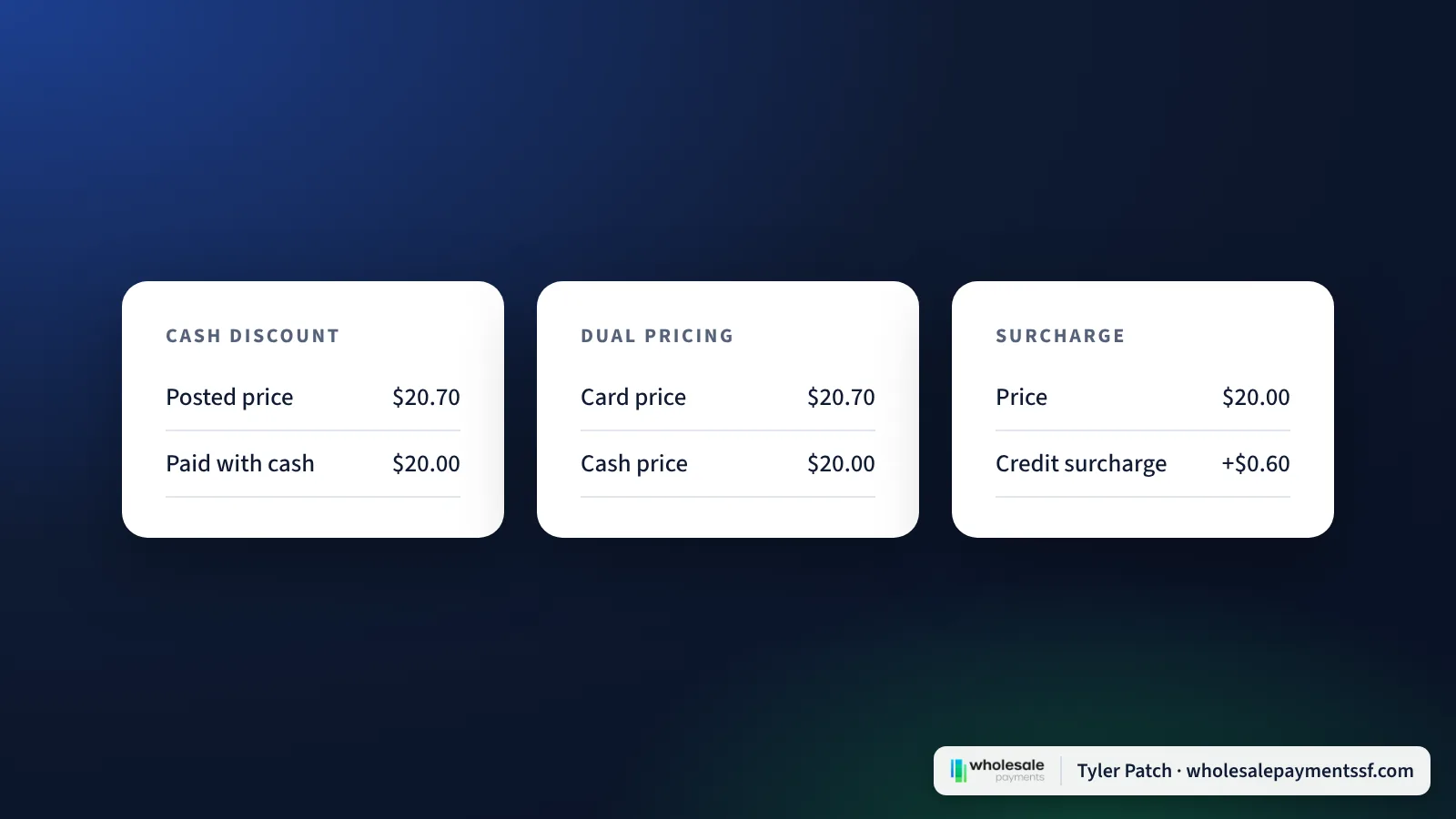
All three programs let you pass card processing costs to customers, but they work very differently. Here is how to tell them apart and pick the right one.
The quick comparison
| Cash discount | Dual pricing | Surcharge | |
|---|---|---|---|
| How it works | Posted price is the card price. Cash customers get a discount. | Cash price and card price both shown. | Fee added on top for credit cards. |
| Covers debit cards | Yes | Yes | No |
| Rules to know | Federal law protects cash discounts; card network rules apply | Generally set up like a cash discount; card network rules apply | Card network rules plus state law; some states ban or limit it |
| Network cap | None | None | 3% under Visa rules |
Cash discount
Your posted prices are card prices. When a customer pays cash, they get a discount. Card customers pay the posted price, which covers processing. It works on credit and debit cards. See how cash discount works for a receipt example.
Dual pricing
Every item shows two prices, cash and card, like a gas station. Customers see both before they pay. It is the most transparent option, and it is popular with restaurants and retail. Read more in dual pricing in Sioux Falls.
Surcharge
A fee is added at checkout for credit cards only. It is capped, can't apply to debit, needs notice to the card networks, and some states ban it. Details are in credit card surcharge laws by state.
Which one saves the most?
For many local businesses, cash discount or dual pricing covers more sales than surcharging, because they apply to debit cards too. Surcharging can fit businesses that take mostly credit cards, like some B2B companies.
What a correct setup usually includes
- Clear signs at the entrance and register
- Both prices, or the discount, shown on the terminal and receipt
- The same card price for every card brand
- A terminal or POS set up to apply it automatically
Frequently asked questions
What law covers cash discounts?
The Durbin Amendment in the 2010 Dodd-Frank Act protects a business's ability to offer a discount to customers who pay with cash. Card network rules and any state rules still apply, so the program has to be set up and disclosed correctly.
Is dual pricing the same as a cash discount?
They are close cousins. Dual pricing shows both a cash price and a card price for every item. A cash discount program posts the card price and gives cash customers a discount.
Which is better, surcharge or cash discount?
For many local businesses, cash discount covers more sales because it applies to debit cards too and isn't subject to surcharge caps. Surcharges can't apply to debit and are banned or limited in some states.
Questions about your own setup? Text Tyler.
General information only, not legal, tax or financial advice. Card network rules and state laws change, so confirm current rules before you change your pricing.