Dual Pricing in Sioux Falls: How South Dakota Businesses Cut Card Fees

Every time a customer taps a card at your counter, a slice of the sale goes to the card networks and your processor. For many Sioux Falls businesses that slice is somewhere between 2% and 4% of every card sale. Dual pricing is the most direct way to stop paying it.
What dual pricing actually is
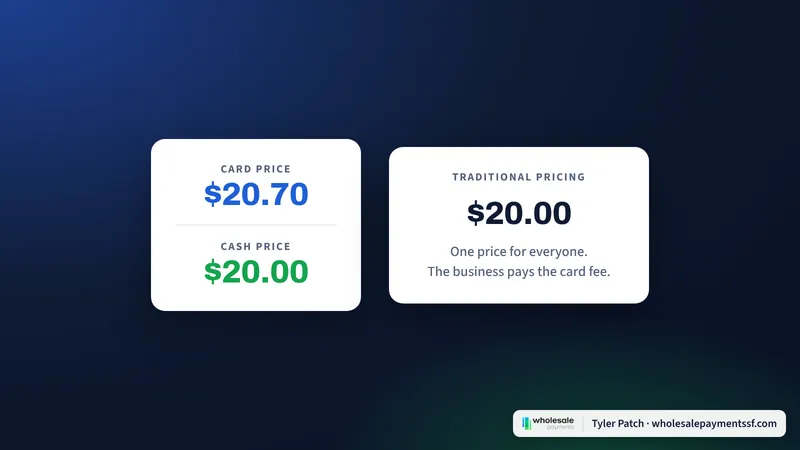
With dual pricing you show two prices: a card price and a cash price. Customers who pay with a card pay the card price. Customers who pay cash get the lower price. The difference covers the cost of card acceptance, so your business keeps the full sale either way.
Gas stations along I-29 and I-90 have done this for decades with "cash" and "credit" prices on the same sign. Today the same idea works at restaurants, shops, auto repair, salons and service businesses, with terminals that calculate and print both prices automatically.
Setting it up the right way
The National Conference of State Legislatures (NCSL) list of state surcharge and discount statutes shows no South Dakota law on either. Card network rules still apply everywhere, and a correct setup usually includes:
- Show both prices clearly at the point of sale, on menus or shelf tags, and on the receipt.
- Use signage at the entrance and checkout so customers know before they pay.
- Treat debit correctly. Federal rules and card network rules restrict extra charges on debit and prepaid cards, so the program has to be configured properly.
- Keep the difference reasonable and consistent with card brand rules.
Your processor should handle the terminal programming, receipt format and signs. Card rules change, so review your setup from time to time. This is general information, not legal advice.
What it looks like at the counter
Say a lunch ticket on Phillips Avenue comes to $20.00 cash. The card price shows as $20.70. The customer taps, the terminal charges $20.70, the receipt shows both prices, and you net the full $20.00 after processing. No extra steps for your staff.
Will customers mind?
Card-price and cash-price displays are now common at restaurants, coffee shops and service counters across the Sioux Empire, so many customers have seen them before. Clear signs at the door and register help, because nobody likes a surprise at checkout. If you'd rather not change anything customers see, there's a second option: traditional processing at wholesale rates.
Questions to ask before you start
- What monthly program fee will I pay, and is it in writing?
- Will the terminal show both prices and print them on the receipt?
- Who provides the signs for the door and register?
- How are debit and prepaid cards handled?
- Can I switch back to traditional processing later?
Frequently asked questions
What rules apply to dual pricing in South Dakota?
Card network rules on showing and disclosing both prices apply in every state. The NCSL list of state statutes shows no South Dakota law on surcharges or cash discounts. Laws change, so confirm with your processor or an attorney.
How much can a Sioux Falls business save with dual pricing?
Dual pricing is designed to cover most or all of your card processing cost. For example, a business processing $40,000 a month in cards at a 3% effective rate pays about $1,200 a month in fees, or roughly $14,400 a year, that dual pricing can recover.
Does dual pricing apply to debit cards?
Debit and prepaid cards have their own federal and network rules. Your processor should configure the terminal so each card type is handled correctly.
Who sets up dual pricing in Sioux Falls?
Tyler Patch, a Wholesale Payments Senior Account Executive based in Sioux Falls, sets up dual pricing for local businesses, including signs and terminal programming.
Questions about your own setup? Text Tyler.
General information only, not legal, tax or financial advice. Card network rules and state laws change, so confirm current rules before you change your pricing.